
No products in the cart.
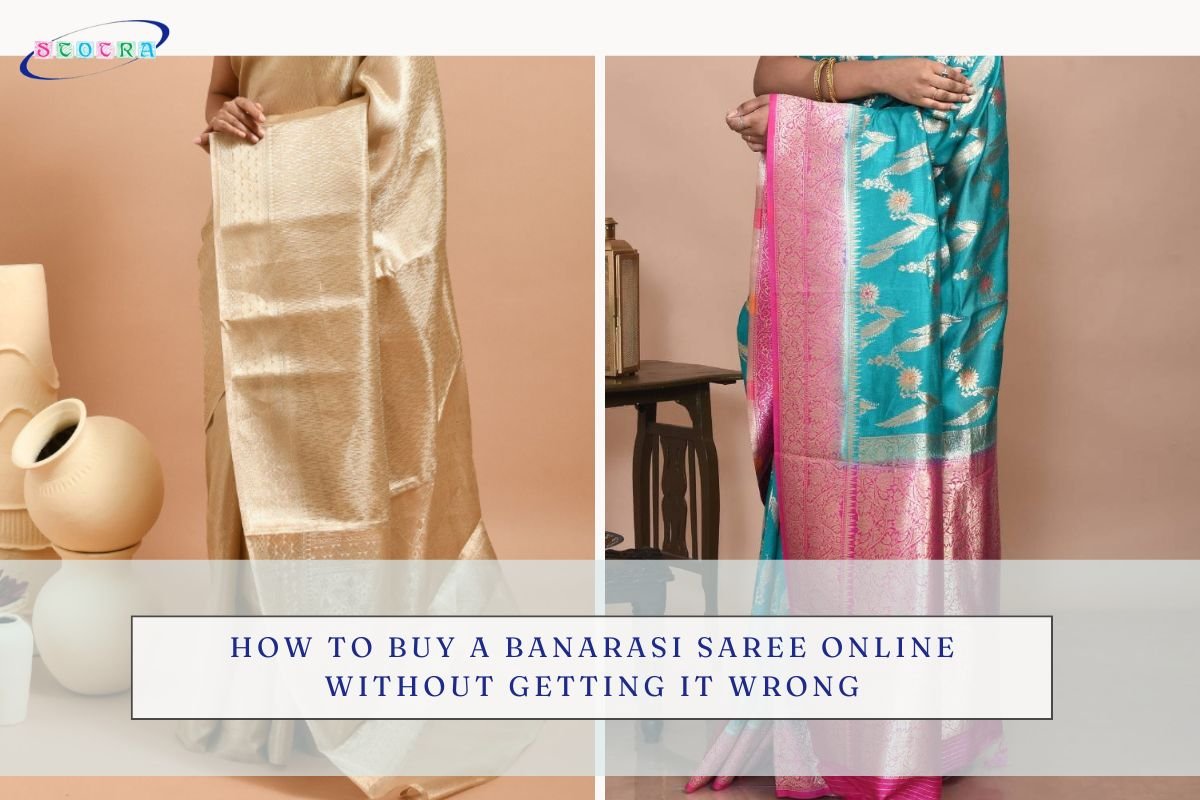
How to Buy a Banarasi Saree Online Without Getting It Wrong
You have seen Banarasi sarees your whole life. At your mother’s wardrobe, your aunt’s Puja dressing table, your cousin’s wedding trousseau. But buying one online yourself is a completely different experience. You cannot feel the weight of the fabric. You cannot hold the pallu up to the light. You cannot ask anyone to show you three more options while you make up your mind.
What you have is a product photo, a fabric description, and a price. And if you get it wrong, the saree that arrives may look nothing like what you expected.
This guide is written to close that gap. By the time you finish reading, you will know exactly what to look for in a listing, how to judge fabric and finish from a photograph, what your budget actually gets you, and how to avoid the most common mistakes first-time buyers make when shopping for Banarasi sarees online.
1. Start With the Occasion, Not the Saree
The single biggest mistake online buyers make is falling in love with a saree before deciding where they will wear it. A tissue silk that photographs beautifully may be completely wrong for a six-hour outdoor wedding in June. A heavily woven piece that looks stunning may be too formal for a daytime family function at home.
Before you open a single product page, answer these three questions:
- When is the event?
Morning functions suit lighter fabrics. Evening events can take heavier, shinier weaves.
- How long will you wear it?
For events longer than four hours, weight and breathability matter more than visual richness.
- What is the formality level?
A wedding function, a festive gathering, and an office cultural event are three very different occasions, even if all three feel like they call for a Banarasi.
Once you have those answers, choosing a fabric becomes much simpler.
2. Know Your Fabrics Before You Browse
Banarasi is not one fabric. It is a weaving tradition applied across several base materials, each of which drapes, feels, and wears differently. Understanding the difference saves you from ordering something that looks right on screen but does not work for your occasion.
Raw Silk Banarasi
Raw silk has a slightly textured, matte finish that is very different from the high sheen of processed silk. It feels somewhat stiff initially but softens with use. The texture holds zari and woven motifs with a grounded, earthy richness that looks particularly good in deep and jewel tones.
Best for: Festive evenings, Puja, semi-formal family functions.
Tissue Silk Banarasi
Tissue silk is woven with metallic threads that create a luminous, lightweight shimmer. It catches both flash photography and ambient light well, which is why it works beautifully for sangeet and evening functions where you know cameras will be around. It is lighter than raw silk and moves more fluidly. A geometric-patterned tissue silk in gold tones, for instance, gives you that celebration-ready shimmer without the heaviness of a full silk saree.
Best for: Wedding functions, evening receptions, sangeet, events where you will be photographed often.
Semi Silk Banarasi
Semi silk uses a blended base with a silk component, making it lighter and more affordable than pure silk while still carrying the traditional Banarasi weave character. It drapes easily, which is helpful for people who do not wear sarees regularly. It holds colour well, including pastels and whites.
Best for: Versatile everyday dressing, cultural events, office functions, anyone wanting a Banarasi that is easy to manage.
Linen Banarasi
Linen Banarasi is the most breathable option in the category. The linen base gives it a relaxed, earthy texture while the Banarasi weave adds surface detail and structure. It does not drape as fluidly as silk but you can wear it comfortably through a warm afternoon without feeling weighed down. A sea green linen Banarasi with a floral Banarasi motif, for example, works just as well for a casual family function as it does for a regular office day.
Best for: Daytime events, summer occasions, office wear, casual festive dressing, anyone new to wearing sarees regularly.
Brocade Banarasi
Brocade refers to the weaving technique where an extra thread creates a raised, three-dimensional pattern on the surface. The result is a textured finish that looks more detailed than a flat weave. Neutral brocade Banarasi sarees work well as wedding guest options because they read as festive without being overwhelming.
Best for: Wedding guest occasions, mehendi and haldi functions, gifting, anyone who wants a Banarasi that works across multiple events.
3. How to Read a Product Photo for Fabric Quality
Since you cannot touch the saree, the product photograph is your most important tool. Here is how to use it properly.
Check the drape, not just the design:
A good product photo shows how the fabric falls naturally. If the pallu looks pinned or arranged in an unnatural position, it may be hiding the actual drape character of the fabric.
Look for close-up detail shots:
A trustworthy listing should include at least one close-up of the body work and the pallu. This lets you assess the clarity of the motif, the consistency of the weave, and the finish of the zari.
Zoom into the zari:
On a good quality close-up, the metallic threads should appear clean and defined. If the zari looks blurry or irregular even in a zoomed image, the finish may not meet your expectations in person.
Judge colour carefully:
Product photography is usually shot under studio lighting, which can make colours appear slightly warmer or cooler than they are in natural light. Violet shades can look more blue on screen. Beige can lean golden. Sea green can appear more teal. Always read the product name and written description alongside the photo because the name is usually the more accurate colour reference.
Check for multiple angles:
A reliable listing shows you the full saree, a detail close-up, and ideally the pallu separately. Single-angle listings do not give you enough information to make a confident decision.
How to Identify a Genuine Banarasi Saree Online
The online saree market has a lot of products described as Banarasi that are not actually woven in the Banarasi tradition. Knowing what to look for helps you buy with more confidence. Here is what to watch for.
Check the seller’s language about sourcing:
Reliable sellers will mention Varanasi or the weaving origin clearly in their product descriptions. Language like “Banarasi-style” or “Banarasi print” is a signal that the product may not be a woven Banarasi saree.
Understand zari types:
Pure zari uses real silver threads coated with gold. Semi-zari uses copper threads with gold coating. Artificial zari uses polyester. All three exist at different price points and a listing at a very low price claiming pure zari should be read with caution.
Price as a quality signal:
Banarasi sarees with genuine weaving and reasonable material quality start from approximately Rs. 2,000 to Rs. 2,500 for lighter fabric options. A listing well below this range claiming handloom or pure silk should prompt closer scrutiny.
Powerloom vs handloom:
Powerloom Banarasi sarees are woven using automated machines that produce consistent, uniform patterns efficiently. They make the Banarasi aesthetic accessible across a wide price range and are a perfectly valid choice for festive and everyday occasions. Handloom Banarasi, by contrast, is woven manually and carries slight natural variations in the weave. Both are genuine Banarasi weaves. What matters is that the listing is honest about which one you are buying.
At Stotra, our Banaras Collection features powerloom woven sarees that bring the traditional Banarasi weave character to everyday and festive dressing at accessible price points. We are transparent about what each piece is so you can make the right choice for your needs and budget.
What Your Budget Actually Gets You
Here is an honest breakdown of what different price points deliver in the Banarasi saree category:
| Budget | What to Expect |
| Rs. 2,000 to Rs. 3,000 | Linen or semi-silk base, lighter zari work, simpler motifs. Good everyday wearability and easy drape. |
| Rs. 3,000 to Rs. 4,000 | Brocade or tissue silk options, more complex weave patterns, richer surface texture. Suitable for most festive and occasion wear. |
| Rs. 4,000 to Rs. 5,500 | More detailed pattern work, better fabric hand, suitable for occasions that call for a polished, put-together look. |
| Rs. 5,500 and above | Pure silk options, finer zari grade, more intricate weave complexity. Better for significant occasions and longer-term wardrobe investment. |
The most important thing to understand is that a higher price does not automatically mean a better saree for your specific needs. A well-chosen linen Banarasi worn at the right occasion will look and feel far more appropriate than a heavy silk worn at the wrong one.
The Detail Most Buyers Overlook: Blouse Piece
Most Banarasi sarees listed online include a blouse piece, typically 80 cm to 1 metre of matching fabric. Before you purchase, confirm the following:
- Does the listing specify blouse piece inclusion? This should be stated clearly in the product description.
- Is the blouse fabric the same as the saree, or a coordinating fabric? For delicate fabrics like tissue silk, the blouse piece is often a coordinating material rather than the saree fabric itself.
- Does the blouse piece accommodate your measurements? Standard blouse pieces typically work up to a 40-inch bust. If you require additional fabric, check with the seller before ordering.
Check the Return and Exchange Policy Before You Add to Cart
Colour variations between screen and reality are the most common reason buyers want to exchange a saree after delivery. Before purchasing from any online store, take two minutes to read the return and exchange policy clearly.
Look for these specifics:
- How many days do you have to raise a return or exchange request?
- Does the saree need to be unworn and unstitched to qualify?
- Is the blouse piece eligible for exchange if cut or stitched?
- Who bears the return shipping cost?
Knowing this in advance means no unpleasant surprises if the shade in natural light turns out different from your screen.
Quick Checklist Before You Click Buy
Run through this before placing your order:
- Does the fabric match the season and duration of the event?
- Have you checked multiple product photos including a close-up of the weave and zari?
- Is the zari type clearly stated in the description?
- Is blouse piece inclusion confirmed?
- Have you read the return and exchange policy?
- Does the colour description in words match what you see in the photo?
- Is the price consistent with the fabric and finish being claimed?
Frequently Asked Questions
What is the best Banarasi saree fabric for a first-time buyer?
Linen or semi-silk Banarasi is the most practical first purchase. Both are lighter, easier to drape, and versatile across occasions. You get the Banarasi aesthetic without the weight or stiffness of heavier silk options.
Is a powerloom Banarasi saree a good buy?
Yes, for everyday and festive occasions, powerloom Banarasi sarees are an excellent choice. They deliver the traditional Banarasi weave patterns and zari work at accessible price points and are widely worn across all kinds of occasions from Puja to office events to wedding functions.
Can I trust the colour shown in product photos?
Most product photos are shot under studio lighting, which affects how colours appear on screen. Always read the written colour description alongside the photo. If you are uncertain, contact the seller before ordering to ask for natural light photographs.
What should I do if the saree looks different from the photos when it arrives?
Photograph it in natural daylight before wearing or stitching the blouse. Contact the seller’s customer support within the stated return window with your photographs. Act quickly as most return windows are between 7 and 10 days.
Does a higher price mean better quality in Banarasi sarees?
Not always. Price reflects fabric type, zari grade, and weave complexity. A well-chosen saree in the Rs. 2,500 to Rs. 3,500 range can look just as beautiful as a more expensive one if matched correctly to the occasion.
Explore the Banaras Collection at Stotra
At Stotra Apparels, our Banaras Collection brings together powerloom Banarasi sarees across fabrics, colours, and price points suited for festive, everyday, and occasion dressing. You will find options ranging from lightweight linen Banarasi sarees in fresh tones like sea green, ideal for day occasions and everyday wear, to tissue silk sarees with golden geometric patterns that are built for evenings and celebrations. Each piece is selected to give you the traditional Banarasi weave character in a format that is wearable, accessible, and honest about what it is.
If you want help choosing based on occasion, budget, or fabric preference, browse our collection or reach out to us directly.